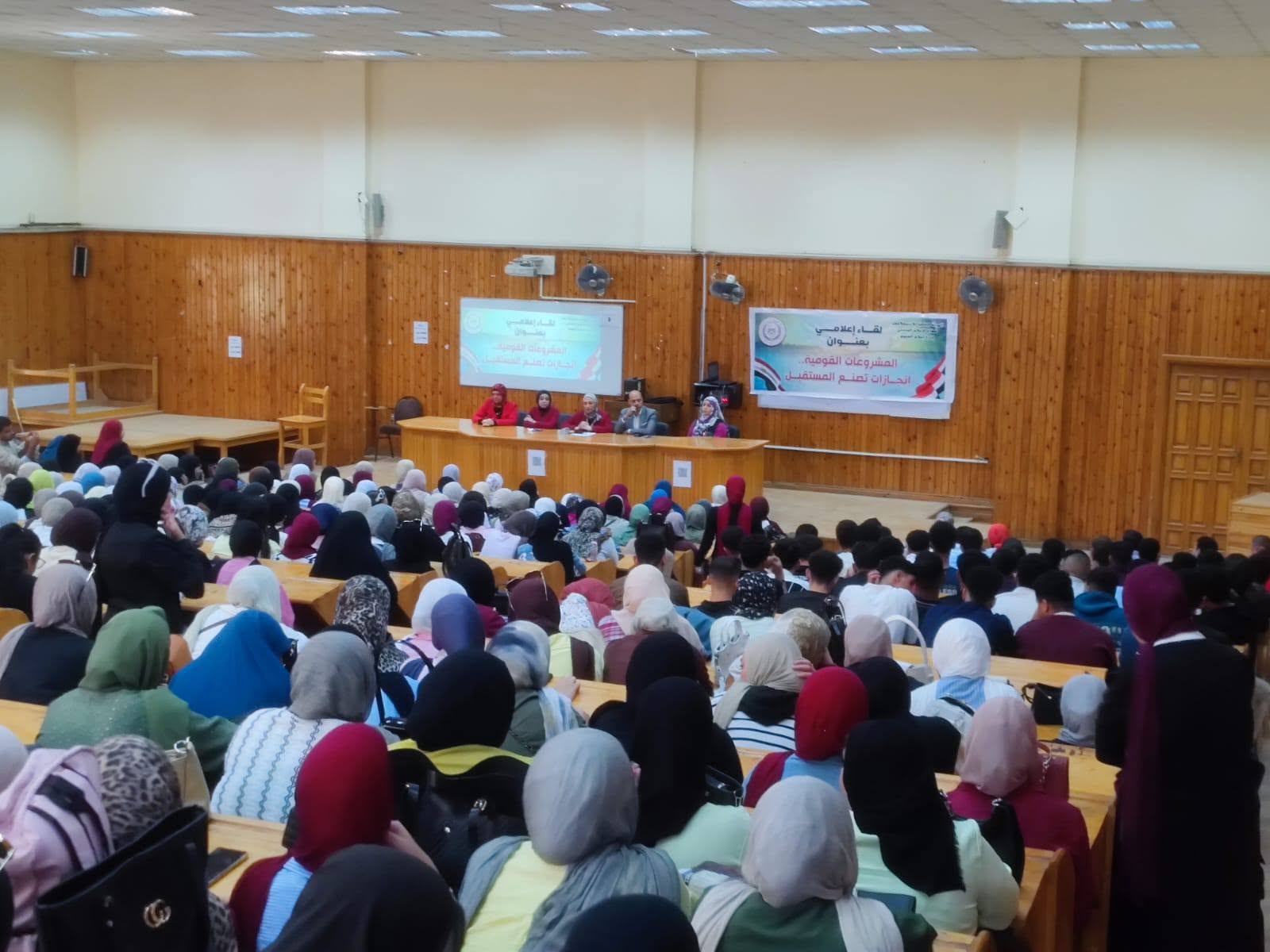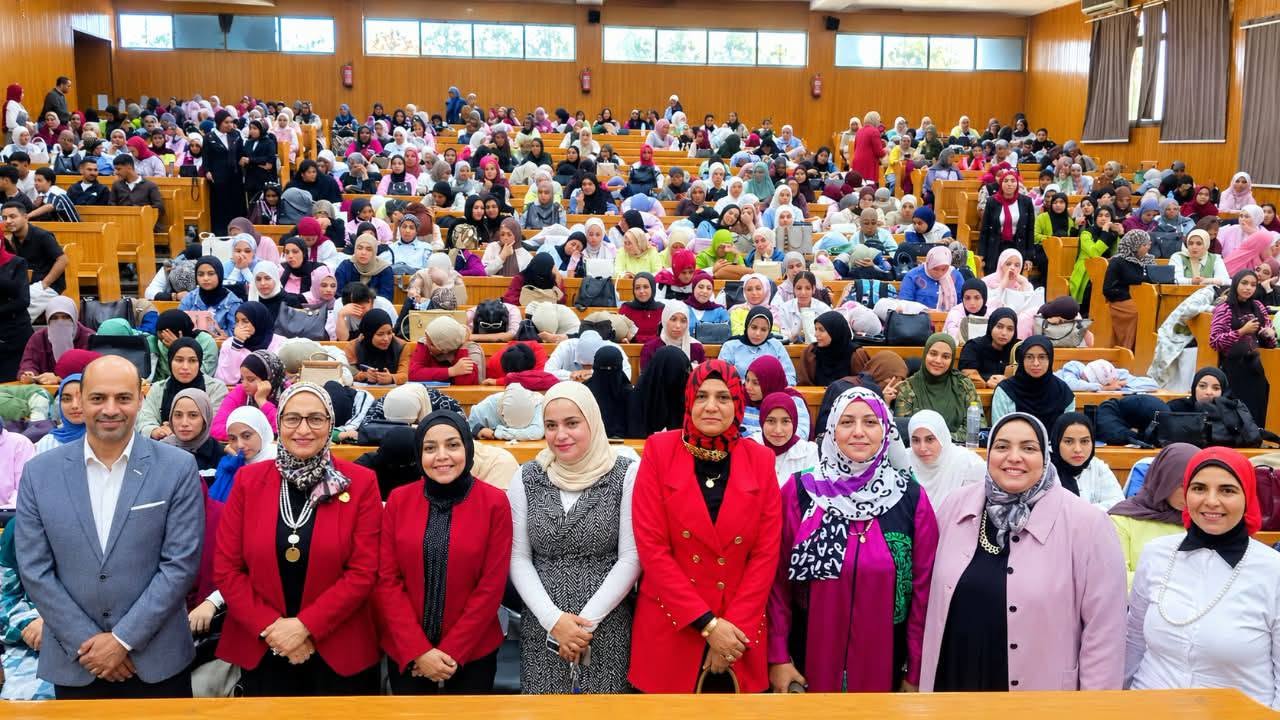


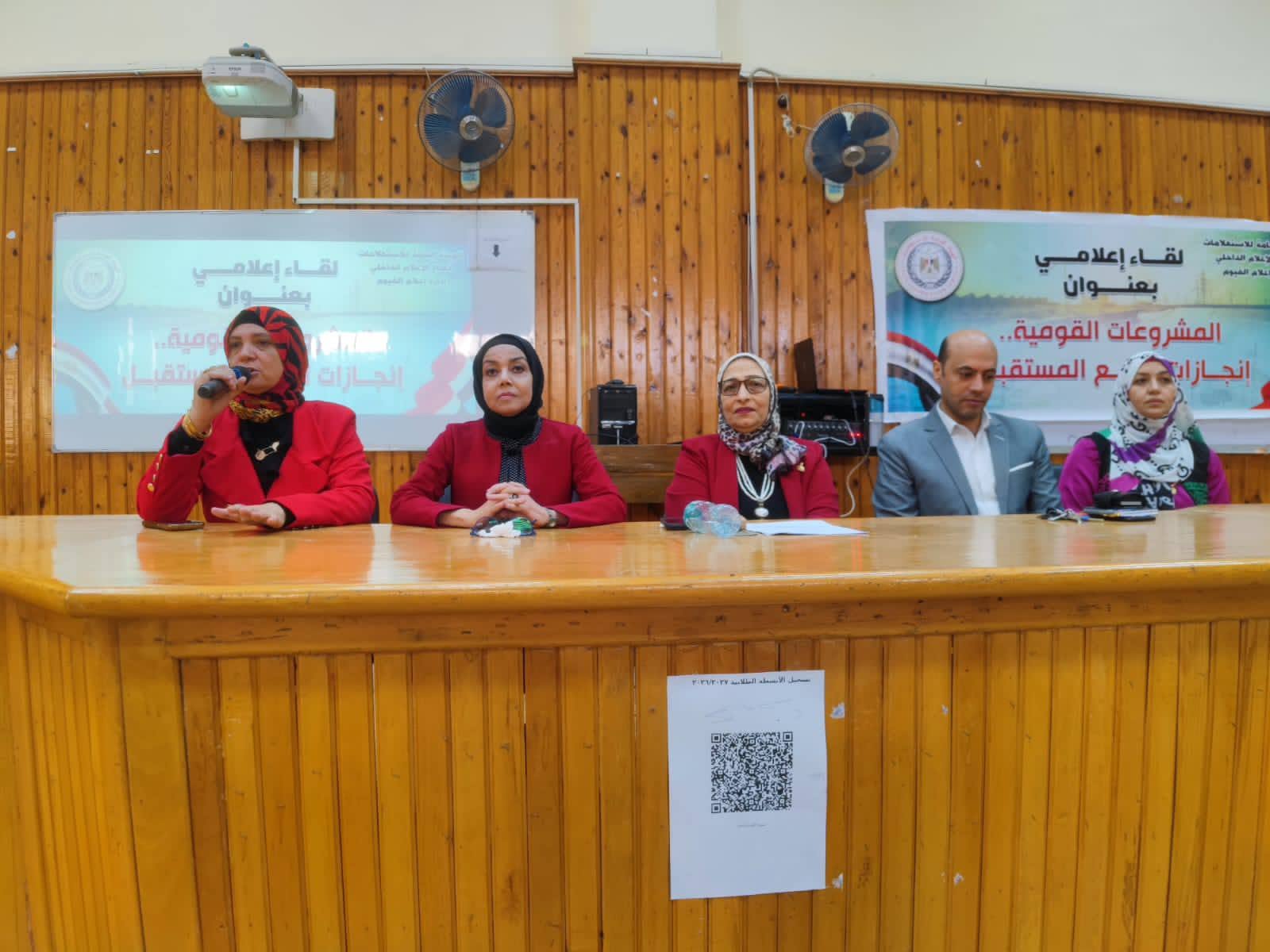
Under the patronage of Prof. Dr. Sherif El-Attar, Acting President of the University, and Prof. Dr. Assem El-Essawy, Vice President for Community Service and Environmental Development, under the supervision of Prof. Dr. Nancy Mohamed Fawzy, Dean of the Faculty, with the coordination of Prof. Dr. Taher Hassan, Vice Dean for Education and Student Affairs, under the leadership of Prof. Dr. Mohamed Omar, Coordinator of the Sports Tourism Program, and Assoc. Prof. Dr. Marwa Abdel-Tawab, Coordinator of Student Activities, and in cooperation with the Fayoum Media Complex of the Domestic Media Sector at the State Information Service, an educational forum was held under the title “National Projects: Achievements That Shape the Future”.
The event was attended by Prof. Dr. Nancy Mohamed Fawzy, Dean of the Faculty; Prof. Dr. Mona El-Khashab, Member of the Senate and former Dean of the Faculty of Agriculture at Fayoum University; Prof. Dr. Mohamed Kamal, Professor of Sociology at the Faculty of Arts and Coordinator of the “For Egypt” student family at Fayoum University; the Fayoum Media Complex team; Ms. Hanan Hamdy, Programs Director; and Ms. Shaimaa El-Gahed, Follow-up Officer; with the participation of a large number of the Faculty’s students and several faculty members.
At the opening of the forum, the Dean welcomed the guests and praised the cooperation with Fayoum Media Complex in raising awareness among university students of national issues. She stressed the active role of youth in building an aware society able to face surrounding challenges, and called for intensified efforts in the “battle for awareness” that the political leadership has urged in several meetings with young people.
Ms. Shaimaa El-Gahed introduced the topic, pointing to the scale of national projects and achievements in recent years and their role in drawing the map of the future for coming generations, and emphasizing the need to strengthen societal awareness of what has been achieved and to help build a national awareness that supports the state. Ms. Hanan Hamdy highlighted the major role of the Domestic Media Sector, through its media complexes nationwide, in building awareness, educating, and strengthening trust between citizens and their institutions through direct media encounters.
Agriculture, Urban Development, and Infrastructure
Addressing the students, Prof. Dr. Mona El-Khashab noted that since 2014 Egypt has been launching a broad package of comprehensive national and development projects aimed at rebuilding infrastructure and expanding agricultural land to boost industrial production and achieve food and energy security. She called for building the awareness of new generations of the importance of these projects for sustainable development, and for not being swayed by rumors that downplay the scale of achievements.
She focused on the importance of national projects in agriculture and urban development, noting that the target was to reclaim 4.5 million feddans, of which 2 million have already been reclaimed, alongside improving irrigation methods, desalination, and the use of groundwater for vertical and horizontal expansion of agricultural land, thereby strengthening strategic reserves and achieving food security. She reviewed the main national agricultural projects, including the New Delta project, the revival and development of the Toshka project, the 1.5 Million Feddan project, the National Project for the Development of Sinai, and the Food Greenhouses project.
She also reviewed national projects in urban development and the construction of new cities to absorb continuous population growth, foremost among them the New Administrative Capital, smart cities, and new cities across governorates, affirming that these projects have transformed the structure of the Egyptian economy and built an investment-friendly environment. She also highlighted key projects in the transport and roads sector, explaining that the National Roads Project aims to build and upgrade road networks to create an environment that attracts foreign investment.
Social Justice, Health, and Education
Prof. Dr. Mohamed Kamal added that these projects aim to improve citizens’ quality of life and redraw the country’s urban and economic map in line with Egypt Vision 2030, stressing their importance in achieving social and health justice. He explained that national projects are a strategy adopted by the state to bring about a qualitative leap across all sectors, noting that citizens’ priorities differ from the state’s, as the state plans for long-term benefit.
He stressed that the current battle is a battle for awareness at all levels, requiring genuine awareness of the value of these achievements and their long-term importance for the sustainable development of future generations, and he noted Fayoum University’s role in raising awareness of them through regular field visits to national projects on the ground.
He reviewed with students the objectives of the national projects, including addressing and upgrading infrastructure, creating jobs, redrawing the community’s development map, and increasing investment. He also reviewed key social justice projects, including the “Decent Life” (Hayah Karima) program for developing rural Egypt and improving living services, and the slum development project to build safer, more urbanized communities. He presented health initiatives as well, including the “100 Million Healthy Lives” initiative, early-detection initiatives for breast cancer, chronic diseases, and hepatitis C, and the obesity treatment initiative, among others that strengthen healthcare. In education, he pointed to upgrading classrooms in villages, technological schools, and the growing number of private and national universities.
At the close of the forum, the floor was opened for dialogue with students, and a documentary film on national projects in recent years was screened.
This comes within the Faculty’s interest in raising youth awareness of the achievements of the political leadership and the Egyptian state, nurturing a sense of belonging among students, and out of its belief in the role of youth in building an aware society able to face challenges.